Practical Tips for Cleaning Boat Hulls with an Electric Pressure Washer

A gentle sea breeze caressed the shore, and the ships moored at the dock shimmered in the morning light. However, the seaweed, salt stains, and sludge accumulated over the years on their hulls and undersides remained faintly visible in the sunlight. This not only affected their appearance but also threatened their performance. For ship owners and dock managers, cleaning the hulls quickly, efficiently, and with minimal damage became a daily necessity. Electric pressure washers, with their high-pressure electric water jet technology, are emerging as a highly efficient tool for anti-fouling cleaning.
This article will provide a comprehensive analysis of the application of electric pressure washers in ship cleaning, covering principles, operating strategies, equipment maintenance, and industry trends. It aims to help ship owners improve their antifouling management efficiency and will also include internal links for further exploration of related in-depth content.
Table of Contents
Why does ship hull cleaning require efficient tools?
When ships are moored in seawater for extended periods, their hulls accumulate seaweed, shellfish, salt stains, oil, and fine silt. These contaminants not only affect the ship’s appearance but also increase water resistance and reduce fuel efficiency. Traditional brushing methods are labor-intensive, time-consuming, and often fail to thoroughly clean grooves, hull crevices, or the surface of the antifouling paint on the hull bottom.
According to industry data, the annual increase in fuel consumption of ships at sea due to fouling can reach 2%-5%, and the hull with severe fouling can even affect the efficiency of the rudder and propeller.
The advent of the electric pressure washer provides boat owners with a solution that combines high-pressure water jets with an environmentally friendly cleaning method, which can remove stubborn stains in a short time while reducing the use of chemical cleaning agents.
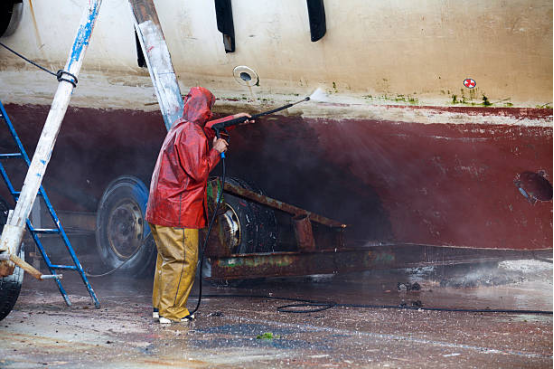
Electric Pressure Washer: Principle Analysis and Anti-fouling Advantages
Electric pressure washers use electricity to drive a water pump, pressurizing the water flow to a high PSI or bar, and then using different types of nozzles to achieve powerful jetting or atomized impact.
- Physical removal of dirt: seaweed, shellfish, and silt attached to the bottom of the ship can be easily removed under high-pressure water flow.
- Protective paint protection: By adjusting the pressure, damage to the anti-fouling paint layer can be avoided, making it safer than traditional brushing methods.
- Cover hard-to-clean areas: corners such as the ship’s side, below the deck, and around the propeller can be reached through the extension tube or rotating nozzle to ensure no blind spots.
Industry experience shows that using an electric pressure washer increases the efficiency of hull cleaning by about 40%-60% compared to manual brushing and significantly reduces the number of times the washing needs to be repeated.
Operational strategy: Steps for efficient hull cleaning
Preparation stage
- Boat securing: Ensure the boat is stationary and use anti-slip mats or brackets to secure the hull and prevent movement during the cleaning process.
- Area protection: Cover vulnerable areas such as electrical conduits, dashboards, and marine lighting fixtures to prevent damage from water or chemical residues.
- Preliminary impurity removal: Use a soft brush or low-pressure rinsing to remove loose sand and large impurities, reducing the impact resistance of high-pressure water flow.
Main cleaning process
- Deck and sides of the ship: Use wide-angle nozzles to spray from top to bottom at a 45° angle to cover large areas of dirt and reduce water splashing.
- Bottom and propeller: Use narrow-angle nozzles to concentrate high-pressure impact, and be careful to maintain an appropriate distance to avoid damaging the anti-fouling coating or mechanical components.
- For detailed cleaning: Rotary nozzles or extension tubes can be used to efficiently wash away stubborn deposits below deck, at hatch edges, and in crevices.
By operating in zones and steps, not only can thorough cleaning be ensured, but water waste can also be reduced and ship maintenance costs can be lowered.
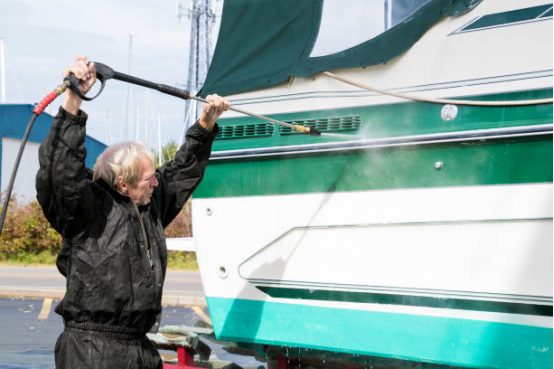
Electric Pressure Washer Equipment Safety
Cleaning safety
- Wear protective goggles, waterproof gloves, and non-slip shoes to avoid injury from high-pressure water jets.
- Control the spray angle and distance to prevent damage to the antifouling paint layer and hull finish.
- Be mindful of environmental safety and avoid splashing water onto electrical equipment or dock facilities.
future
With increasingly stringent environmental regulations and ship maintenance standards, ship cleaning is transitioning from manual scrubbing to efficient, environmentally friendly, high-pressure water jet cleaning. This trend includes:
- Low chemical usage: The electric pressure washer uses high-pressure water to reduce reliance on chemical cleaners, making it more environmentally friendly.
- Intelligent control: Multiple pressure modes, rapid nozzle switching, and rotating nozzle expansion enable efficient and precise cleaning.
- Service standardization: Ports and docks are gradually adopting unified cleaning operation standards to ensure the long-term performance and energy-saving goals of ships.
Summarize
Hull cleaning not only affects the vessel’s appearance but also directly impacts navigation efficiency and fuel consumption. The electric pressure washer provides an efficient, precise, and environmentally friendly cleaning solution using high-pressure electric water jets, achieving thorough cleaning from decks and sides to the hull bottom and antifouling paint surfaces.
Through the operational strategies, maintenance recommendations, and industry trend analysis presented in this article, ship owners and dock managers can efficiently maintain ship performance while ensuring safety. Gain a deeper understanding of efficient cleaning solutions.
Are you ready to restore your boat’s shine and extend the life of your antifouling paint? With the Electric Pressure Washer, you’ll have it all under control.