Is an Electric Pressure Washer Suitable for Indoor Use? — An In-Depth Look at Safety, Ventilation, and Noise

“Can I use that high-pressure floor washer in a factory, garage, or basement?” This seemingly simple question involves a host of complex factors, including safety, environmental considerations, and device compatibility. For many, electric pressure washers are a must-have for outdoor use; however, to determine their suitability for indoor use, we must consider three key factors: safety, ventilation, and noise. This article will explore the feasibility and limitations of electric pressure washers in indoor environments from a neutral and practical perspective, focusing on these considerations.
Safety: The first threshold for indoor use
Electrical safety and leakage risks
An electric pressure washer is essentially a device powered by a high-voltage motor pump. If used in a humid environment, water splashing onto outlets, junction boxes, switches, or damaged insulation on power cords can easily cause electrical short circuits and electric shock. This is especially true indoors, where water cannot quickly disperse and dry; water mist lingers in the air for extended periods, significantly increasing the risk.
Therefore, if you want to use a high-pressure washer indoors, make sure the following points are basic requirements:
- Use a power line with a residual current device (GFCI/RCD);
- All wires and sockets should be waterproof, splash-proof or covered with sealed covers;
- The insulation layer of the equipment body, hose and spray gun must be kept in good condition without cracks, wear and aging;
- Do not spray directly at electrical fixtures, switch panels, electrical outlets, or wiring conduit entries;
- Operators should wear basic protective equipment such as insulating shoes and waterproof gloves.
In addition, in some countries or regions, indoor high-pressure cleaning involving factories and workshops may also be subject to OSHA or local electrical safety regulations. Regulations must be followed.
Water jetting and structural risks
High-pressure water jets exert a powerful impact. Prolonged spraying of indoor surfaces, such as walls, tiles, glass, and metal panels, can peel off coatings, cause cracks and shedding, and lead to water seepage into the wall structure. These risks are exacerbated indoors because water can bounce off a specific point, impacting surrounding components, and splash angles are more difficult to control.
For example, Matt The Driveway Guy’s article points out that using pressure washing indoors can cause secondary problems such as water accumulation in hidden structures, water absorption by wood, damp walls, and mold growth.
In general, even if you have the most advanced Electric Pressure Washer, you cannot ignore the side effects of this “impact force”.
Indoor pollution and suspended particle release
Water impacts sediment, oil, old paint, and dust, potentially introducing these particles or chemicals back into the air, causing air pollution. This is especially true in older buildings and factories, where wall coatings may contain lead paint, paint flakes, and dust may contain heavy metals and oil residue. These particles, disturbed by the water flow, can be dispersed in mist, posing a respiratory risk.
Matt’s article reminds: “Indoor high-pressure washing may cause pollutants such as mold spores, lead paint flakes, and asbestos to enter the air along with water vapor.”
Therefore, if indoor high-pressure spray cleaning is required, a pollutant assessment should be performed first, and if necessary, local sealing or ventilation and exhaust dust control measures should be performed first.
Example Alert: Product Safety Recall
It is worth mentioning that the U.S. CPSC (Consumer Product Safety Commission) recently recalled some Ryobi brand Electric Pressure Washers on a large scale because their capacitors posed a risk of overheating and explosion, causing injury to users.
This case demonstrates that even under “normal use,” devices can harbor inherent risks. Even more caution is advised when using them in restricted indoor environments. Therefore, before using a device indoors, be sure to verify that the device is a reliable brand, has safety certifications, and is safe from recalled models.
Ventilation Control: Humidity and Airflow Management in Indoor Spaces
Even if you take adequate electrical safety measures and minimize the risk of impact, air humidity and ventilation issues may still become stumbling blocks.
Humidity and water mist accumulation
High-pressure spray cleaning creates a mist of water droplets suspended in the air. In poorly ventilated indoor spaces, these droplets can become trapped and condense on ceilings, walls, furniture, and electrical equipment, causing a damp, damp feeling, and corrosion of metal components. This long-term problem can actually worsen the problem.
To prevent humidity accumulation, it is recommended that:
- Forced exhaust: Use a high-volume exhaust fan or air handling system to quickly exhaust moisture outdoors;
- Local water collection/water collection curtain: Lay water collection troughs, curtains, and plastic partitions under the spraying area to control the direction of water flow and prevent the spread of water mist;
- Control the duration and intervals of operations: avoid prolonged spraying, which would expose the room to water mist continuously; intermittent operation, opening windows for ventilation, and using fans to draw air can alleviate humidity;
- Use dehumidification equipment: Dehumidifiers can be deployed in indoor environments (such as workshops and factories) where conditions permit to maintain relative humidity within a safe range.
Airflow design and wind direction planning
The wind pressure and mist dispersion generated during the spraying process can also alter indoor air flow. Proper arrangement of the spray direction, inlet/outlet vent locations, and fan placement is crucial. Avoid pointing the nozzle directly at the vents to blow water back, and avoid allowing mist to become trapped in blind spots.
In industrial indoor cleaning, some companies are using Electric Pressure Washer systems designed specifically for indoor use (such as food processing workshops and manufacturing plants) – they emphasize lower noise than fuel-powered machines, no exhaust gas, and can be used indoors.
However, these modes can only operate safely in an industrial environment with a complete exhaust system, water collection system, and humidity control system. This does not mean that they can be used by just plugging them in an ordinary home garage.
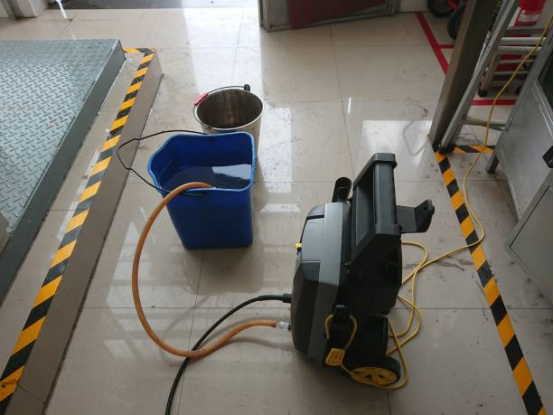
Noise Control: Sound Quality Challenges in Indoor Environments
is “ElectricA common misconception is: “Electric ones are definitely quiet and fine for indoor use.” This is not the case.
Electric vs. Gas: Noise Baseline Comparison
Indeed, compared to the 90–100 dBA roar of a fuel-powered compressor, electric-powered equipment is much quieter. Hotsy’s documentation mentions that electric washers are typically as noisy as household washing machines, making them more suitable for indoor, enclosed, or sensitive environments.
Consumer Reports also pointed out in its review that fuel-pressure engines often produce noise of at least 85 dBA, which is a threat to hearing, while electric models tend to be in a lower noise range.
But this is just an ideal comparison. In reality, motors, pumps, pipes, spray guns, and water impact can all generate noise (such as housing resonance, bubble agitation, and return pipe hum). In indoor environments, these noises are amplified by echoes and room structure resonance.
Indoor noise amplification effect
In enclosed rooms (with hard surfaces like walls, ceilings, and floors), sound without proper sound-absorbing materials can easily reverberate and overlap. Even if the equipment itself only produces 70-80 dBA, it can sound “harsh” indoors. For spaces like workshops, laboratories, warehouses, and garages, noise control should be addressed from the source.
Noise control measures
If you really want to use the electric pressure washer indoors, we recommend the following noise reduction measures:
- Choose low-noise models/silent series equipment
- Install a soundproof cover or sound-absorbing material box on the outside of the machine
- Use flexible damping devices (spring pads, vibration damping pads) to isolate resonance
- Place the device as close to the corner or partition as possible and attach sound-absorbing panels to the wall.
- Limit operating time periods to avoid operating during sensitive periods of the day or night
- Operators should wear hearing protection (such as noise-reducing earmuffs). Even electrically powered equipment may exceed the safe hearing threshold, and standards such as OSHA recommend wearing hearing protection during high-pressure cleaning.
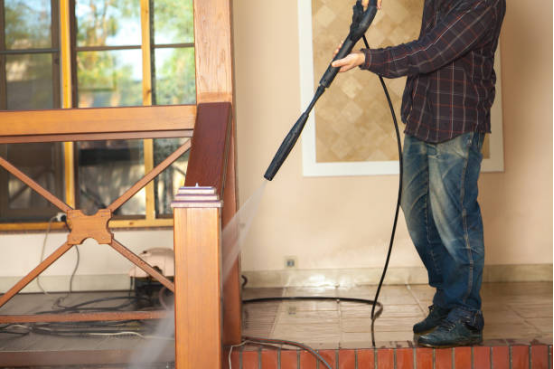
Indoor use? Yes, but with extreme caution
To sum up, the use of electric pressure washers indoors is not an absolutely forbidden area, but it must be done under extremely cautious and strictly controlled conditions.
The following is a summary of the judgment ideas:
- If the space is an industrial/commercial environment such as a workshop, factory, car wash, or logistics warehouse and has complete ventilation, drainage, and humidity control facilities, then it is possible and feasible to use electric cleaning equipment designed specifically for indoor use.
- If it is a semi-enclosed space such as a home garage, a small car wash room, or a basement, the risks are higher: electrical safety, water rebound, humidity accumulation, noise amplification, and air pollution may all become problems.
- If you still want to try it, you should do the following: leakage protection + fully sealed/waterproof circuit + forced ventilation + control of operation time + noise reduction measures + protective equipment. You should also do a small-scale trial wash first and evaluate the impact of humidity and equipment.
- Alternative options are to use in semi-open spaces, or switch to more suitable indoor solutions such as low-pressure cleaners, steam cleaners, dry mist cleaning, etc.