How Electric Pressure Washers Help Property and Gardening Management: A B2B Application Perspective

In the chain of property management and garden maintenance, “cleanliness” is a fundamental yet often overlooked link. Walk into an office building or a high-end residential complex, and you’ll see years of accumulation of dirt, moss, bird droppings, and dust on exterior walls, floors, landscape stone, storm drains, and flowerbed curbstones. This not only detracts from the overall appearance but can also shorten the lifespan of the facilities.
This is where a reliable electric pressure washer’s value in B2B scenarios becomes apparent: it can become a powerful tool in the maintenance systems of property management companies, gardening teams, and landscape contractors. This article will analyze its role in property and gardening management, operational strategies, maintenance logic, and industry trends from four perspectives.
1. Why do property/gardening managers need an Electric Pressure Washer?
Image value + asset maintenance
Property management emphasizes the principle of “appearance reveals character.” Mottled exterior walls, stained floors, moss on landscaping stones—these details are integral to a building’s brand image in the eyes of clients, tenants, and visitors. Regularly high-pressure washing exterior walls, curtain wall joints, balcony railings, and stone paving helps maintain a pristine appearance. As Valcourt points out, pressure washing can remove grease, mold, graffiti, rust, and other stains, positively impacting both the building’s appearance and structure.
On the other hand, long-term scale accumulation can mask cracks, allow water to penetrate the structure, and cause coating loss or material damage. Property management literature often emphasizes pressure washing as a preventative maintenance method that helps extend the life of facilities such as floors, walls, drains, and drainage pipes.
Gardening + Hardscape Maintenance Needs
Gardening areas incorporate not only greenery but also stone paving, paths, seating, sculptures, flower pots, fences, and other diverse materials. These hard surfaces are exposed year-round and prone to algae growth, dust accumulation, and mildew in humid environments. Pressure washing plays a crucial role in gardening projects, both in terms of trimming and finishing touches and reshaping the landscape. Hardened paving, landscape flagstones, and plastic tiles for paths can all be “revitalized” with high-pressure water jets. Wet Inc., in its gardening/landscape services, mentions that high-pressure water jets can effectively remove stubborn stains and biofilm (moss, green algae, lichen, etc.), restoring the original appearance of hard landscape surfaces.
In B2B scenarios, this “hardscape cleaning” capability brings three benefits to property management/gardening teams: improving the aesthetics of the environment, reducing the risk of slips (wet stone is slippery due to algae and moss), and reducing long-term maintenance costs.
Advantages compared to other maintenance tools
Compared to traditional manual scrubbing, water spraying, and chemical agents, the Electric Pressure Washer offers the following advantages in commercial environments:
- High efficiency : can cover a large area in a shorter time;
- Strong controllability : pressure, flow rate and nozzle can be adjusted to adapt to different materials;
- Environmentally friendly and safe : no fuel, no exhaust gas, and if used with a suitable cleaning agent, the amount of chemicals used can be reduced;
- Mechanical standardization : facilitates training and process-based operation and maintenance, rather than relying on manual feel like scrubbing.
Therefore, it is becoming increasingly common to include high-pressure cleaning equipment in the standard contract and operation and maintenance list in property or gardening contracting services.
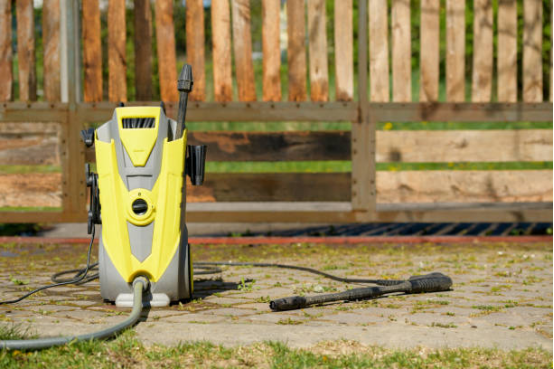
B2B Application Strategy: How to Deploy Electric Pressure Washers in Property and Gardening Projects
To make this device truly useful, it takes more than just buying it. Here are a few strategies that must be considered at the business/team level.
Equipment selection and specification matching
Property/gardening projects often involve a variety of materials and sizes. When choosing an Electric Pressure Washer, consider:
- Power and pressure (PSI or bar) : Must cover common cleaning surfaces such as exterior walls, stone, and brick. Models with slightly higher power are more suitable for B2B applications.
- Flow rate (GPM or L/min) : Cleaning efficiency is closely related to flow rate.
- Hot and cold water compatibility/heating module : Some stains (such as grease and industrial residue) are more effectively treated with hot water.
- Accessory and accessory compatibility : For example, surface cleaners, spray arms, long pipes, hose reels, extension cords, etc.
- Durability and ease of maintenance : The high frequency of use of equipment in commercial scenarios requires a modular design and a structure that can easily replace pump heads/seals.
- Mobility/maneuverability : whether there is a vehicle-mounted bracket, a towable unit, a wheeled mobile platform, etc.
It is recommended that teams discuss these factors with manufacturers during the initial procurement phase and, if possible, conduct pilot projects to verify the performance of the equipment in real property/horticultural environments.
Business process embedding + service packaging
The property or gardening company should modularize cleaning services in the contract as part of the regular maintenance services. For example:
- Regular exterior wall/ground cleaning : quarterly, semi-annual, and annual exterior wall scrubbing, entrance floor cleaning, and driveway stain treatment.
- Landscape stone/hardscape cleaning : paths, squares, stone steps, pavilions, sculpture bases, etc.
- Crisis cleaning response : such as bird droppings cleaning after the holidays, emergency treatment of advertising graffiti, drainage ditch cleaning, etc.
The service contract should clearly specify the cleaning frequency, equipment type, responsibility boundaries (which materials are allowed to use high pressure), and additional charges (such as paint removal, glue removal, and heavy stain treatment) to avoid subsequent disputes.
In terms of business processes, operating standards should also be standardized, such as protecting plants in advance, covering electrical equipment, choosing appropriate nozzle angles, and sequential operations (from top to bottom, from edge to center).
Personnel training and safety management
The risk cost on the commercial side is high, and incorrect operation may damage the building surface or injure people. There should be a standard training process:
- Operating specifications (nozzle distance, angle, movement speed)
- Maximum pressure allowed by different materials
- Protection standards: goggles, gloves, non-slip shoes, etc.
- Equipment daily inspection and maintenance process
- Emergency response (accidental water hammer, equipment failure, water leakage, chemical reaction)
In addition, cleaning logs, task records, and equipment maintenance records should be set up to ensure that maintenance and responsibility can be traced.
Cost-effectiveness and ROI assessment
In B2B scenarios, purchasing decisions often consider return on investment (ROI). Key considerations include:
- Equipment depreciation and maintenance costs
- Labor savings (how many times more efficient is high-pressure cleaning than manual scrubbing)
- Delayed repair/replacement costs (cleaning maintenance can reduce water seepage, crack expansion, re-coating, etc.)
- Improve tenant satisfaction/economic premium brought by brand value
If the property management company can present the cost details, savings comparisons, and case data of the cleaning service, and show the rationality of this investment to the owners and tenants, it will be easier to gain support in the budget.
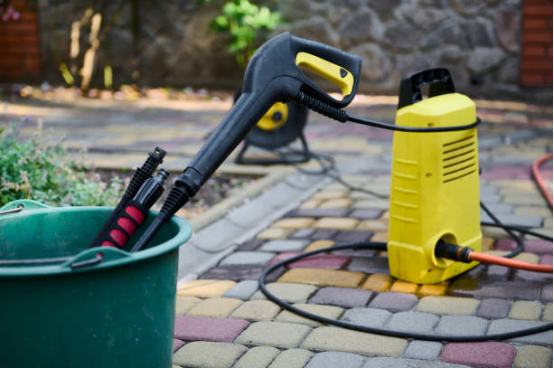
Operation maintenance and equipment life assurance
Once the Electric Pressure Washer is embedded in the daily operation and maintenance system, how to ensure its stable operation? This is the key to the success of B2B applications.
Daily maintenance and care
- Inlet water filtration and softening treatment : prevent impurities and sediment in the water from entering the pump body and nozzle, causing wear or blockage
- Nozzle/quick connector inspection and cleaning : Regularly replace the sealing ring and clean the nozzle hole
- Check the seals/gaskets in the pump body : Aging of the high-pressure pump seal is one of the main causes of failure
- Pressure relief valve/safety valve adjustment : ensure stable pressure, no pulses or overpressure
- Inspection of pipes/joints/hose : prevent local leakage, hose bulging, and loose joints
- Motor/drive component inspection : Ensure coils, bearings, and cooling systems are functioning properly
- Drainage and antifreeze treatment in winter/out of service period : avoid residual water causing freezing and internal damage
These maintenance measures need to be systematized and institutionalized, and implemented in accordance with the equipment warranty agreement and manufacturer’s manual.
Spare parts strategy and modular design
On the business side, equipment downtime is extremely costly. Recommendations:
- Reserve key spare parts (such as seals, nozzles, pump core parts)
- Optional modular quick-change components
- Establish a rapid response system with suppliers (faulty parts can be quickly replaced offline and then replaced after repair)
- Regularly assess the end of life cycle of equipment and plan replacement nodes
Fault monitoring and data feedback
For large-scale property or park managers, consider adding a monitoring module to the device:
- Monitor running time, frequency, load pressure, and flow data
- Fault alarm (such as abnormal pressure, flow fluctuation, overheating)
- Record the operation map/operation area for future maintenance optimization and cost accounting
The data capabilities of this “smart high-pressure cleaning equipment” will become part of the B2B competitiveness.
Industry trends and business opportunities
Although the application of Electric Pressure Washers in property and garden management is not new, its prospects are being redefined with the evolution of technology, energy and market structure.
Increased demand for green/emission-free products
As society’s demand for low-carbon, emission-free, and environmentally friendly equipment grows, property management and landscaping companies will increasingly turn to electric, zero-emission equipment. Electric pressure washers naturally fit into this trend, offering a promising alternative to diesel and gasoline high-pressure washers.
The rise of intelligence and IoT
Future cleaning equipment may include automated task scheduling, remote control, and feedback adjustments. Property management systems (PMS) may integrate high-pressure cleaning tasks into a unified scheduling platform, managing them across budgets, tasks, history, testing, and inspection reports.
Service Outsourcing Market Opportunities
Some property management or landscaping companies may not be able to maintain their own cleaning teams, so they outsource to cleaning service providers. In this case, service providers with specialized electric pressure washers, along with standardized processes and equipment, can stand out in the B2B contract competition.
Compatible with comprehensive maintenance/integrated service model
In the future, property services will no longer be separated into three distinct areas: landscaping, cleaning, and security. Instead, they will converge into integrated facilities operations and maintenance services. High-pressure cleaning can be bundled with services such as drainage system maintenance, exterior wall painting, and roof repairs to form part of a comprehensive service package.
Cross-region/special scenario expansion
High-end industrial parks, scenic areas, development zones, commercial complexes, and other locations with high environmental quality requirements have a greater demand for electric pressure washers. This is especially true in rainforest climates, coastal areas, and tropical high-humidity regions, where algae, moss, and salinity deposits are more severe, necessitating the frequency and value of high-pressure cleaning.
Make cleaning a competitive advantage in property and gardening
In the B2B value chain of property and garden management, the Electric Pressure Washer is more than just a piece of machinery; it’s a powerful tool for maintaining environmental quality, extending asset life, and enhancing brand image. By integrating it with standardized operations and maintenance procedures, training systems, and equipment maintenance mechanisms, your team can gain a competitive advantage in efficiency, safety, and image.