How to use an electric pressure washer to clean playground and outdoor fitness equipment.

Early mornings often reveal the most problems in playgrounds. After a night of rain, a layer of grayish-white water stains remains on the slides, the handrails feel sticky to the touch, and the rubber mats on the ground are covered with fine sand and fallen leaves. Outdoor fitness areas are in a similar state; the handles are covered in sweat and airborne dust—seemingly inconspicuous, but accumulating risks day after day. It is in this environment that the electric pressure washer has gradually become one of the most frequently mentioned equipment cleaning tools in playground cleaning and public facility maintenance.
Rather than a simple “rinse,” this is more accurately described as a systematic cleaning process that addresses safety, hygiene standards, and maintenance efficiency. This article will break down the logic behind the application of electric pressure washers in playgrounds and outdoor gyms, starting from real-world usage scenarios and combining common industry practices. It will also focus on discussing easily overlooked safety precautions.
Why are playground and outdoor fitness equipment harder to clean?
Many managers underestimate the complexity of pollution in these facilities. Playground equipment is exposed to all weather conditions; ultraviolet radiation, rain, and airborne particles work together to create an aging layer on the surfaces of plastics, coated metals, and composite materials that is difficult to detect with the naked eye. This layer more readily attracts dirt and is more difficult to clean with ordinary water pipes.
The problems with outdoor fitness equipment are more related to “human factors.” Frequently touched handles, seats, and footrests, combined with sweat, sebum, sunscreen residue, and airborne dust, easily form stubborn, film-like dirt. Traditional mopping or brushing methods are inefficient and can leave secondary contamination in the crevices.
For this reason, the electric pressure washer is considered a solution that balances efficiency and coverage in the category of equipment cleaning tools. By controlling the pressure and water volume, it can perform large-area, non-contact cleaning without disassembling the equipment.
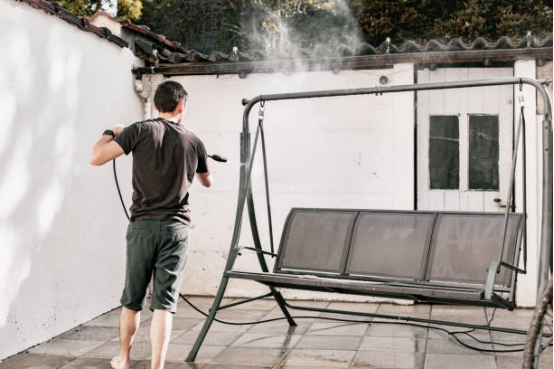
The working logic of an electric pressure washer in public facility cleaning
In principle, an electric pressure washer isn’t about “the higher the water pressure, the better.” In playgrounds and outdoor fitness areas, the real key is controllability. A stable motor output makes it easier to maintain pressure within a range suitable for plastics, rubber, and powder-coated metals, preventing surface damage from sudden high pressure.
In actual playground cleaning cases, maintenance personnel typically operate in sections. They first wet the surface with low pressure to soften dirt and residue, then gradually advance using a fan-shaped water flow. This method is safer than spot flushing and is more in line with public facility maintenance standards.
The advantages are even more pronounced when using outdoor gym pressure washer equipment. The equipment has a complex structure and many blind spots, but a high-pressure water jet, at the right angle, can reach areas that are difficult for humans to access, reducing the time and safety risks associated with manual disassembly.
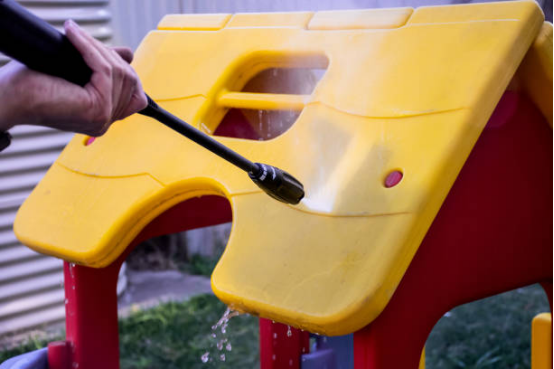
Preparation before cleaning is more important than the cleaning itself.
In industry experience, cleaning accidents often don’t occur during operation but rather stem from insufficient preparation. Before using an electric pressure washer, the first step is not to connect it to power but to check the surrounding environment and usage conditions.
First, crowd control is crucial. Playgrounds and outdoor fitness equipment are high-frequency public areas, and cleaning operations involving an electric pressure washer must be carried out during off-peak hours, with clear barriers and signage to prevent children or pedestrians from accidentally entering the work area.
Secondly, equipment inspection is necessary. Loose bolts and aging plastic parts are more susceptible to damage under the concentrated output of an electric pressure washer. Checking and marking these areas in advance allows operators to reduce pressure settings or avoid direct water flow during cleaning.
Finally, there’s the issue of ground conditions and drainage. High-pressure cleaning with an electric pressure washer generates a large amount of runoff in a short time. If drainage is poor, wastewater can be carried back onto the equipment surface, affecting the final cleaning result and increasing slip risks.
Safety and cleaning boundaries of different materials
A fact that is often overlooked is that playground equipment and outdoor fitness equipment are not made of “uniform materials.” When using an electric pressure washer, understanding material differences becomes especially important. The shells and mats of slides, climbing frames, and fitness equipment have significantly different tolerances to pressure intensity and water temperature.
Plastics and composite materials are more susceptible to surface fatigue and micro-cracking under concentrated pressure. When cleaning these areas with an electric pressure washer, it is recommended to maintain an appropriate spray distance and rely more on water volume rather than impact force. For rubber mats, attention should be paid to the water flow angle to avoid lifting edges or washing away underlying infill materials.
While metal structures generally tolerate higher pressure from an electric pressure washer, bearings, joints, and lubrication points should not be repeatedly flushed. In professional equipment cleaning tool practice, many maintenance teams adopt a “quick pass” approach in these sensitive areas, reducing the risk of moisture intrusion while still achieving surface cleanliness.
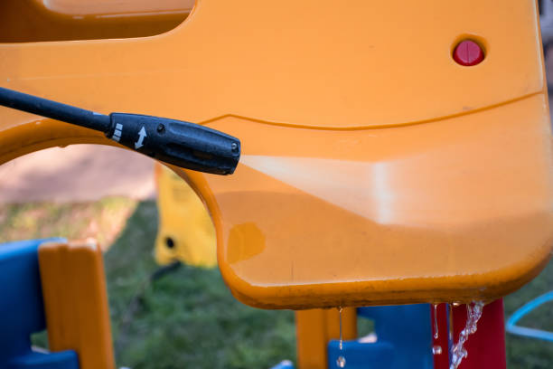
Safety is not only for equipment but also for operators.
The safety risks of electric pressure washers are not limited to the objects being cleaned. Operator fatigue and impaired judgment during prolonged operation can also lead to problems.
Industry recommendations often mention three points: non-slip shoes, protective gloves, and anticipation of reaction forces. High-pressure water jets generate rebound force when encountering curved surfaces or edges; if the grip is not firm, it can easily lead to loss of control of the spray gun.
In addition, electrical equipment has specific requirements regarding the power supply environment. Waterproof sockets and residual current devices (RCDs) must be used for outdoor operations, and direct connection to the power source should be avoided in areas with standing water. These details are repeatedly mentioned in many accident reviews, yet they are still easily overlooked.
The Real-World Relationship Between Cleaning Effectiveness and Hygiene Standards
In public facility maintenance reports from some cities, areas that regularly use electric pressure washers showed significantly lower levels of surface bacteria and visible stains compared to areas that only underwent manual scrubbing. This doesn’t mean that high-pressure washing itself has a disinfecting function, but rather that it more effectively removes contaminants, creating conditions for subsequent basic disinfection.
For playgrounds, visual cleanliness directly impacts parents’ trust; for outdoor fitness areas, it determines whether users are willing to linger. An efficient and consistent cleaning process is an integral part of public space management.
The work is not over after the cleaning is completed.
Many people consider the final rinse the end of the process, but in professional maintenance, inspection and record-keeping are equally important. After cleaning, a quick inspection is necessary to check for cracks, looseness, or peeling coatings exposed by the water flow. If these problems are not addressed promptly, they can amplify risks in the next usage cycle.
At the same time, recording the time, method, and problems found during each playground cleaning or outdoor fitness equipment cleaning helps to establish a long-term maintenance routine, rather than passively responding to complaints.
Returning to the initial scenario, when children run back onto the slide and gym-goers grip the equipment again, they often have no idea what kind of cleaning process has taken place behind the scenes. But it is precisely these seemingly repetitive, even somewhat tedious, tasks that determine whether public spaces can be used safely and sustainably.
The electric pressure washer isn’t the “star” of the show; rather, it’s a tool that makes cleaning more controllable and efficient. Its true value lies in a comprehensive understanding of the environment, materials, and people. The next time you see a playground or outdoor fitness area being cleaned, perhaps pay closer attention to the details—they are often more important than they appear on the surface.