When should you not use an electric pressure washer?

In the arsenal of modern home maintenance, the Electric Pressure Washer is undoubtedly the sharpest “scalpel”.
Pulling the trigger and watching 2000 PSI (pounds per square inch) of water instantly peel away a decade’s worth of moss, oil, and grime is not only visually reassuring but also potentially addictive.
However, as the fundamental laws of fluid dynamics state, energy doesn’t disappear; it simply transfers. When this immense kinetic energy strikes a surface, if it’s not completely absorbed by the dirt, the remaining energy must be absorbed by the surface itself.
This energy is devastating for many materials.
When we discuss “When Not to Use Pressure Washer”, we are essentially exploring a physical game concerning yield strength. When the impact stress of the water flow exceeds the bonding force on the material surface, the original “cleaning” process can turn into an irreversible “microscopic geological disaster.”
Today, we will put away that “water gun” and, from the perspective of materials engineering, delve into the five high-pressure forbidden zones that must never be touched.
I. The Nightmare of Organic Fibers: Wood and Composite Deck
If you search for “Pressure Washing Deck” on YouTube, you’ll see countless satisfying comparison videos. But this is often the beginning of a trap. From a botanical and structural mechanics perspective, wood is a porous composite material made of cellulose and lignin, and its microstructure resembles bundles of tightly bound straws.
1. Fiber tearing and “fuzzing”
When you use high pressure (especially with a 0-degree or 15-degree nozzle) to impact cork (such as pine or cedar) at close range, the high-pressure water jet is not just removing surface dust; it is actually performing “hydraulic cracking”.
Water pressure breaks the lignin bonds that hold wood fibers together, causing countless tiny fiber spikes to instantly rise up on the originally smooth wood surface. This phenomenon is known in engineering as “furring”.
Consequences: This isn’t just an aesthetic issue. The surface area of the roughened wood increases dramatically, making it absorbent like a sponge.
If you plan to stain or oil it afterwards, the pigment won’t penetrate evenly, resulting in a mottled and unsightly appearance. More seriously, these protruding splinters can easily prick barefoot family members.
2. Destruction of the sealing layer
Many outdoor timbers undergo preservative treatments or surface coatings for protection. The peeling power of a high-pressure water jet far exceeds your imagination; it can strip away the chemical coatings that protect the wood like peeling a banana.
Once this protective layer is lost, the wood is directly exposed to UV rays and rainwater, and the rate of decay (Rot) will increase by 5-10 times.
Engineering recommendations: When cleaning wooden decks, the pressure should not exceed 1200 PSI, and a fan nozzle (40-60 degrees) must be used. A better option is to use a soft wash, which uses the chemical action of sodium percarbonate solution to break down mold, rather than relying on physical force.
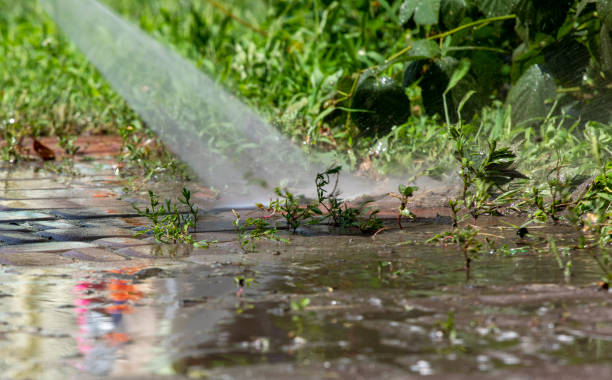
II. The Hidden Killers of Mineral Structures: Brick Walls, Concrete, and Plaster
This is an extremely costly misconception. Many homeowners believe that brick and concrete are indestructible and should withstand high-pressure cleaning. However, from a materials science perspective, both brick and concrete have their Achilles’ heels.
1. Mortar Erosion
The structural strength of a brick wall depends not on the bricks themselves, but on the mortar that holds them together. Especially in older houses built before the 1950s, the hardness of the lime mortar is much lower than that of modern cement.
High-pressure water acts like an invisible chisel on the mortar. Under continuous impact, the mortar can be peeled off in chunks or even hollowed out.
Structural risks: Mortar loss can lead to loosening of the wall structure.
Worse still, the resulting voids become natural rainwater reservoirs, directly threatening the wall’s insulation performance and structural stability.
2. Pressure-induced water ingress and “spilling”
Even if you don’t directly wash away the mortar, high-pressure water can cause more insidious damage: Deep Water Ingress. The pressure of an electric pressure washer is enough to force water molecules into the tiny capillaries of the brick or concrete surface. This moisture can remain deep within the material and is difficult to evaporate naturally.
The disaster of freeze-thaw cycles: When winter comes, the water trapped inside freezes and expands (increasing in volume by about 9%).
This internal tension forces the brick surface to break through from the inside out, causing the entire brick to peel off like an eggshell. This phenomenon is called spalling in civil engineering, and repairing it means replacing the entire brick.
3. Stucco exterior wall (Stucco/EIFS)
Modern stucco exterior walls are essentially a thin layer of acrylic or cement coating. High-pressure water jets can easily penetrate this thin layer, causing moisture to seep into the insulation layer or wooden frame inside the wall, triggering hidden mold outbreaks and structural rot. For these types of surfaces, high-pressure cleaners are absolutely forbidden tools.
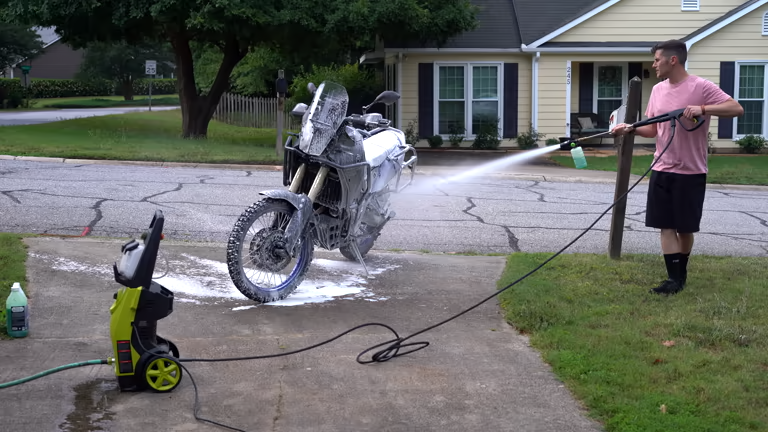
III. Chemical Damage to Rubber: Tires and Automotive Components
Car washing is one of the most common uses of Electric Pressure Washers, but many people don’t realize that they are shortening the life of their tires.
1. Loss of antioxidants
Tires are more than just rubber; they are complex chemical formulations. To resist the corrosive effects of ultraviolet light and ozone, special waxes and antioxidants are added to the rubber during tire manufacturing.
These components slowly migrate to the tire surface over time, forming a protective layer. When you use a high-pressure water jet to wash the tire sidewalls at close range, you not only wash away the dirt but also forcibly peel off this chemical protective film.
Warning sign: If you find that the tire surface is brown (blooming) after high-pressure washing and drying, it means that the antioxidants have been excessively removed.
This can lead to premature aging and cracking of the rubber (Dry Rot).
2. Structural hazards
If you are using an extremely powerful nozzle (such as a 0-degree red nozzle), the water stream can even cut into the rubber, creating microcracks invisible to the naked eye.
At high speeds, these microcracks can expand rapidly under high temperature and pressure, increasing the risk of a tire blowout.
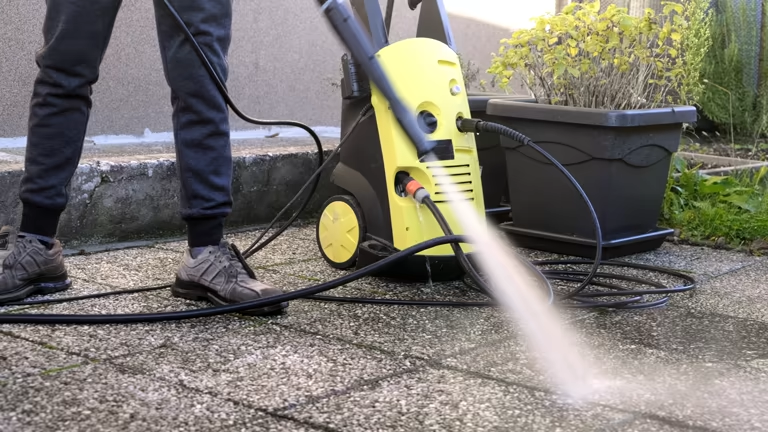
IV. The Nemesis of Precision Machinery: Heat Exchangers and Electronic Components
In the field of mechanical maintenance, electric pressure washers are often misused for cleaning air conditioner outdoor units and engine compartments. This is a classic case of “good intentions gone wrong.”
1. Deformation of heat dissipation fins
Whether it’s the condenser of a home air conditioner or the radiator of a car, the core component is a densely packed array of aluminum fins. To maximize heat dissipation area, these fins are made extremely thin (typically only 0.1 millimeters thick).
The impact of an electric pressure washer is devastating to these fins. Even a moderate pressure water flow, with a slight deviation in angle, can instantly crush and flatten large sections of the fins.
Consequences: The collapsed fins will completely block airflow, causing the compressor to overheat, energy consumption to skyrocket, or even rendering the entire device unusable.
2. Water intrusion in the engine compartment
While the engine bay exudes a rugged, metallic feel, the space beneath the hood of modern cars is packed with sophisticated sensors, ECUs (electronic control units), and fuse boxes.
Although these components are designed to be water-resistant, that’s to protect against rain splashes, not from 1500 PSI pressurized water jets.
Short circuit risk: High-pressure water flow can easily break through rubber seals and seep into the connector, causing pin corrosion and short circuit.
Even more dangerous is the possibility of water being accidentally forced into the air intake, which could cause engine “hydraulic lock-up”, bending of connecting rods, and complete engine failure.
V. The Red Line of Biosafety: Humans and Pets
Finally, and most importantly: the Electric Pressure Washer is not a toy, nor is it a tool for bathing pets or having water fights in the summer.
High-Pressure Injection Injury
This is an extremely dangerous type of trauma in emergency medicine. When a fluid with a pressure exceeding 100 PSI comes into contact with human skin, it can pierce the epidermis like a syringe needle. The pressure of a pressure washer is typically 15 to 30 times that value.
Deceptive wounds: The most terrifying aspect of this type of injury is that it may appear to be just a small red dot or abrasion, with minimal bleeding.
However, beneath the skin, a high-speed stream of water may have severed nerves and tendons, and flushed bacteria, grease, and dirt into deep muscle tissue.
Medical emergency: If surgical debridement is not performed immediately, this type of wound is highly likely to cause compartment syndrome, leading to tissue necrosis and an extremely high amputation rate.
Therefore, never point a nozzle at any living creature, even as a joke.
Alternative: The Rise of Soft Wash Technology
Since high-pressure cleaning has so many limitations, what should we do when faced with dirt on delicate surfaces? The answer is: Soft Wash.
This is the current mainstream trend in the professional cleaning industry. Its core logic is “chemistry triumphs over physics”.
- Specialized cleaning agents: Use sodium hypochlorite or sodium percarbonate solution, combined with professional surfactants.
- Low-pressure spraying: Use a special nozzle to apply the cleaner to the surface at extremely low pressure (similar to the pressure of a garden hose, about 60 PSI).
- Dwell Time: Allow the chemical agents to remain for 10-15 minutes to automatically decompose the roots of mold, algae, and dirt.
- Low-pressure rinsing: Finally, rinse away the residue with plenty of low-pressure clean water.
This method not only avoids all the aforementioned physical damage, but also, because it kills the spores at the source, the cleaning time is often 2-3 times longer than that of high-pressure cleaning.
Establishing a sense of boundaries in engineering
Owning an Electric Pressure Washer doesn’t mean you have the privilege of destroying all dirt; it means you take responsibility for managing this enormous energy.
From the lattice arrangement of macrocrystalline quartz to the cell walls of wood, everything in the world has its limits. Understanding “When Not to Use a Pressure Washer” is not about denying the value of this tool, but rather about establishing a “professional sense of boundaries” based on scientific understanding.
A qualified home maintainer knows how to be as precise as a surgeon: wielding the spray gun with ease on concrete driveways, proceeding cautiously in front of old red brick walls, and decisively putting away the spray gun in front of air conditioner units.
Using tools scientifically is an act of reverence for nature and a way to protect the creations in our hands.
FAQ: Frequently Asked Questions
Q1: If my pressure washer has a pressure adjustment knob, can I turn down the pressure to wash my car?
Theoretically, yes, but be very careful. Even with lower pressure, it’s recommended to use it with a foam cannon to allow the foam to pre-flow and carry away dirt and sand.
Finally, use a wide-angle fan-shaped spray (40-degree white nozzle) to rinse, keeping the nozzle at least 30 cm away from the paint. Never use the high-pressure water jet to “pry” bird droppings off your car; you’ll scrape off the paint along with them.
Q2: Since I can’t wash the air conditioner fins, how should I clean them?
Use a specialized “Fin Cleaner”. This foam spray foams and automatically pushes out the dirt, then you can gently rinse with a regular watering can or a low-pressure stream of water.
For bent fins, you can use an inexpensive tool called a “fin comb” for physical repair.
Q3: Why do my wooden decks have zebra-striped streaks after washing?
This is called “Lap Marks”. This is because you were moving the nozzle at varying distances or at uneven speeds during washing, resulting in inconsistent depths of cutting into the wood surface.
This is an irreversible physical change and can usually only be repaired by sanding the entire deck. That’s why we recommend Soft Wash for beginners.