Repair or Throw Away? Electric Pressure Washer Repair Costs and Reset Decision Guide
On a Saturday when you’ve planned to thoroughly clean your terrace, you connect the hose, press the switch, and expect a powerful roar, only to be met with an awkward silence or a weak, feeble trickle.
At that moment, your first reaction might be anger, followed by confusion: Is this electric pressure washer that has served you for two years able to be fully restored simply by replacing a part, or has it been completely reduced to scrap metal?
Most people fall into two extremes: either spending hundreds of dollars repairing a machine worth only a hundred dollars because they can’t bear to throw it away, or throwing away equipment with a simple capacitor failure in the landfill because they lack technical knowledge.
As an observer who has disassembled thousands of machines in this industry, I’ve found that this is not just a technical issue but also a mathematical problem. Today, we won’t talk about sentimentality, but only about minimizing losses and building a cost-based electric pressure washer repair guide decision matrix for you.

Golden Rule: 50% Cost Threshold
If the total cost of repair (parts cost + your time value) exceeds 50% of the price of a new machine with equivalent performance, do not hesitate to throw away the old machine.
This isn’t waste; it’s rational asset mitigation. Many entry-level electric pressure washer systems are designed from the outset as “limited-life consumer goods,” not heirlooms. Their pump bodies are often one-time sealed, and the cost of forced repairs is often higher than you might imagine.
Before assessing whether it’s worth the effort, you need to examine whether your cleaning needs have evolved. Sometimes, machine malfunction is a signal that you need to rethink your entire home’s electric pressure washer cleaning system. Perhaps what you need now is a high-flow commercial machine rather than fixing that barely adequate entry-level model.
Green Zone: Three Minor Flaws Worth Fixing
If your machine exhibits the following symptoms, don’t rush to buy new parts. These three types of malfunctions usually involve inexpensive parts, are easy to repair, and allow the machine to run stably for a long time after repair.
1. The motor only makes a whirring sound but doesn’t turn? Check the capacitor.
This is the most common and easily misdiagnosed fault. When you press the switch and hear the motor making a low “humming” sound but not turning, it is usually not that the motor is burned out but that the starting capacitor is faulty.
The capacitor acts like a “helping leg” for the motor, providing the starting torque. All you need to do is open the casing and locate the cylindrical part. Replacing the capacitor in a pressure washer typically costs less than $20 and only requires a screwdriver and a pair of needle-nose pliers. Simply replace it with a new capacitor of the same specifications, and the machine will usually be back to normal almost instantly.
2. Gun shut-off without stopping? The unloader valve is stuck.
Under normal circumstances, releasing the trigger should cause the machine to enter bypass circulation or automatically shut down. If your machine stalls or experiences fluctuating pressure after releasing the trigger, the culprit is usually the unloading valve.
This component is responsible for regulating the direction of water pressure. It can easily get stuck due to scale buildup or spring fatigue. Removing it, cleaning it, and applying grease often solves the problem.
3. Pressure leak? O-rings
If your machine is spraying water everywhere like a colander, preventing pressure from building up, that’s actually the best news. A standard set of O-rings is even cheaper than a cup of coffee. When you check the piping diagram of an electric pressure washer step by step, you’ll find it’s just simple physical wear and tear, with no core mechanical damage whatsoever.
Red-light districts: a terminal illness that must be scrapped.
However, reality is often harsh. If your electric pressure washer experiences either of the following two situations, please immediately stop investing any money and time.
1. Cracked Pump Housing
This usually happens after winter when you forget to drain the excess water. When you discover cracks in the pump body (whether aluminum or brass) accompanied by significant leakage, the game is over.
While welding is theoretically possible, the strength of the weld joint is difficult to guarantee under high pressure (even at 2000 PSI). Replacing the entire pump head typically costs over 70% of the total price of the unit. In this case, there is no alternative but to buy a new one.
2. Motor burnout
If you smell that distinctive, pungent, burnt electrical odor and see “magic smoke” rising, it means the motor winding insulation has melted.
For home appliances, the cost of rewinding coils or replacing the motor is absurd. Instead of lamenting over scrap metal, it’s better to explore the latest electric pressure washer on the market and see how far technology has evolved.
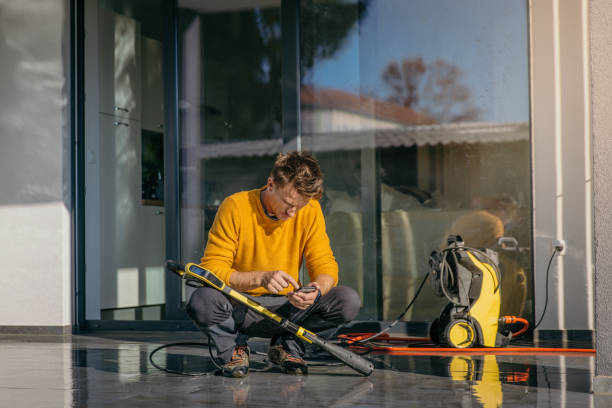
Troubleshooting logic: Start with software troubleshooting, then move to hardware troubleshooting.
When faced with a malfunctioning machine, many people immediately start disassembling it, which is a mistake. Efficient troubleshooting should follow the logic of “from the outside in.”
Often, you rush to search for “troubleshoot electric pressure washer no pressure,” only to find that the problem is simply that the inlet filter is clogged with algae or the nozzle is blocked.
- Check the water inlet: Is the flow rate sufficient? Is the filter screen clean?
- Check the nozzle: Try a different nozzle and see if the pressure returns.
- Check the power supply: Is there power in the socket? Has the residual current device (RCD) tripped?
Only after these external factors have been ruled out can we proceed with disassembling and inspecting the internal components.
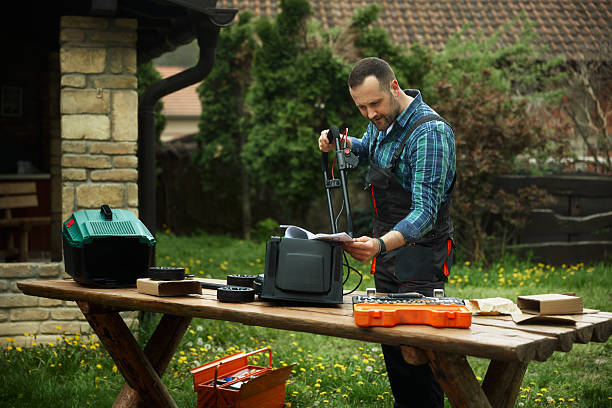
Rational decision-makers
At the end of the electric pressure washer‘s life cycle, your decision should not be based on “nostalgia,” but on “value.”
If it’s just a matter of replacing a capacitor or an O-ring, DIY repair is not only cheaper but also very satisfying. However, if the core component is damaged, let it go. Remember, your time is also a cost. Instead of spending an entire weekend struggling with a pump that’s destined to fail, use that budget to upgrade to a new device with an induction motor and a better warranty.
Actionable Tip:
If your machine breaks down, don’t disassemble it yet. Find the dusty instruction manual (or download it from the official website) and turn to the “Troubleshooting” page at the end. If the steps above don’t work, then use the “traffic light” principle in this article to determine the faulty part. If it’s a red light fault, immediately cut the power cord (to prevent misuse), and then start looking for a new machine.
FAQ
1. Why is my machine running normally but without pressure? (troubleshoot electric pressure washer no pressure)
If the motor runs normally but no water comes out or the pressure is extremely low, in 90% of cases, there is air in the system (air resistance) or the inlet filter is clogged. First, try turning on the machine and letting water flow for 1 minute without connecting the nozzle to purge the air. If this doesn’t work, check and clean the transparent filter at the inlet. If there is still no pressure, the check valve may be stuck, requiring disassembly and cleaning of the pump head.
2. Where can I find a reliable electric pressure washer repair guide?
Besides the brand’s official website PDF manual, YouTube is the best source of video guides. Be sure to include your specific model number when searching. However, note that the general repair logic is to first check the easily worn parts (O-rings, nozzles), then the electrical parts (switches, capacitors), and finally the mechanical parts (pump head, pistons). Following this order will save you a lot of time.
3. How to determine if it is necessary to replace the capacitor in the pressure washer?
Two typical symptoms: First, the motor makes a “humming” sound but doesn’t turn when turned on. If you can turn the fan by hand (be careful; use a tool for assistance), then the capacitor is faulty. Second, the capacitor shows signs of bulging, leakage, or burning. If either of these occurs, replacing the capacitor for a few dollars will usually solve the problem.
Related Posts
Why do electric pressure washers need to run idle periodically?
-
Posted by
 Marcus Whitfield