Electric Pressure Washer vs. Professional Cleaning Services

Bills often arrive faster than stains. The floor has just been cleaned, and the invoice is already in the mailbox; the equipment looks brand new, but the next appointment is already booked. Many people only begin to hesitate at this moment: is this kind of cleaning method really suitable for long-term use?
The comparison between electric pressure washers and professional cleaning services is repeatedly brought up in this kind of real-world scenario. On the surface, it’s a choice between DIY and professional cleaning; in reality, it’s more like a comprehensive judgment about time, cost, and decision-making methods.
Table of Contents
From “How much money did it cost this time?” to “What happened this year?”
The most obvious advantage of professional cleaning services is their predictability. A single appointment, a single quote, and the cleaning results are clearly visible. For ad hoc, unexpected cleaning needs, this model requires almost no planning. However, the problem also lies precisely in this “one-time” perspective.
In many industry analyses comparing pressure washer costs, it has been found that when cleaning needs are cyclical—such as for patios, parking areas, public walkways, or outdoor facilities—outsourcing costs can accumulate unnoticed. The first bill may seem reasonable, the second acceptable, but the numbers only become alarming when tallied up at the end of the year.
The emergence of the electric pressure washer is not intended to negate professional services but rather to add another dimension to decision-making. The difference between a one-time investment and an ongoing expenditure only becomes truly apparent when viewed over a longer time frame.

Flexibility is not efficiency, but control.
Many people mistakenly believe that “cleaning yourself” means lower efficiency. The reality is often the opposite. The efficiency of outsourced cleaning relies on standardized processes: fixed times, fixed tasks, and fixed procedures. However, real-world environments don’t always cooperate.
Falling leaves, continuous rainfall, and construction dust can all cause cleaning needs to be brought forward or postponed. Professional teams may be able to handle these situations, but each adjustment means re-communication, re-quoting, and rescheduling.
The electric pressure washer embodies a sense of control. Whether to clean today, to treat only a localized area, and to address stains as soon as they are discovered are all decisions made by the user. This is why “immediacy” is frequently mentioned in discussions about outdoor cleaning service alternatives—not just faster completion, but eliminating the need to wait.
The most easily overlooked part of cost comparison
When discussing costs, people often only look at the explicit figures. The cost of a single professional service seems naturally comparable to the cost of purchasing one’s own equipment. However, in actual use, there are some implicit factors.
For example, communication costs. Repeatedly explaining requirements, confirming scope, and clarifying special areas—this time doesn’t appear on the bill, but it’s definitely consumed. Another example is environmental adaptability. Outsourcing teams, for the sake of general efficiency, may not make subtle adjustments for every material or surface condition.
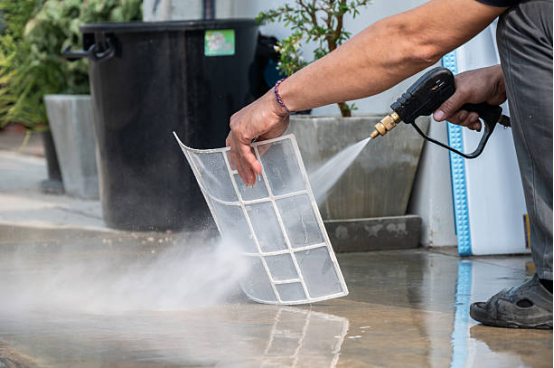
The cost structure of electric pressure washers is more biased towards “usage frequency.” The more you use it, the lower the cost per use; the less you use it, the less obvious the advantage. This is also a common conclusion in pressure washer cost comparisons: it is not suitable for everyone, but once it is matched with the usage scenario, the return will gradually increase.
The irreplaceable nature of professional services remains.
A rational discussion must acknowledge the fact that not all cleaning tasks are suitable for self-management. For tasks involving heights, specialized chemical treatments, and commercial spaces with stringent regulations, professional cleaning services remain irreplaceable.
Some user feedback suggests that the electric pressure washer is more of a “routine maintenance tool” than a “comprehensive replacement solution.” It addresses high-frequency, predictable cleaning needs with relatively controllable risks, allowing professional services to be reserved for scenarios where professional intervention is truly required.
This division of labor actually makes the overall cleaning costs and management pressure more balanced.

The key to decision-making lies not in the equipment, but in the user.
One easily overlooked perspective is that choosing an electric pressure washer is essentially choosing a way to participate. Are you willing to personally understand the cleaning rhythm? Can you determine when to clean and when to postpone? These factors all influence the final experience.
In long-term comparisons between DIY and professional cleaning, satisfaction is often related to a sense of “control.” For some, doing it themselves is a burden; for others, it’s a way to reduce uncertainty.
Treat choices as a system, not as a stance.
Returning to the original question: Electric pressure washer or professional cleaning services, which is better? The answer is not on one side.
Truly mature judgment often involves not taking sides but rather combining different approaches. Which areas are suitable for independent management, and which situations require external support? Which expenditures are one-off, and which are long-term? Once these questions are clarified, the choice itself becomes less agonizing.
Perhaps the next time you face a cleaning bill, you won’t just focus on “how much it cost,” but rather on “what this decision will bring a year from now.” When your level of thinking changes, the meaning of tools and services will also change.