How is water pressure generated in an electric pressure washer?

When you pull the trigger of the cleaning gun and watch the stubborn dirt being peeled off instantly, have you ever wondered how exactly this “water dragon” that can cut through dirt is created?
To many, the electric pressure washer is like a black box—water goes in at one end and sprays out at the other. But from an engineering perspective, it’s a sophisticated energy conversion experiment.
This is not just about power but also about reshaping the physical structure: how to transform ordinary tap water flow into highly destructive kinetic energy. Today, we disassemble the outer shell, from the power source to the pump’s heart, to provide an in-depth analysis of how a pressure washer works.
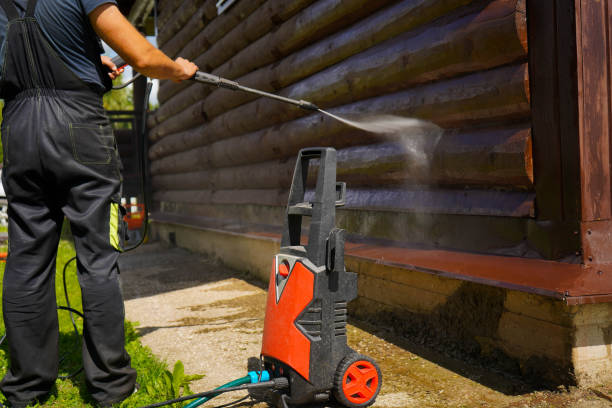
Deconstructing the “Water Dragon”: How a Pressure Washer Works
1. Source of Power: From Electrical Energy to Mechanical Energy
The heart of every electric pressure washer is a high-speed electric motor.
Energy Conversion: The core task is to convert electrical energy into mechanical energy. The motor output shaft is connected to the pump unit, which provides the initial power for the subsequent pressurization process through thousands of rotational speeds per minute (RPM).
Limitations: Rotation alone is not enough. Water does not automatically generate pressure simply because the motor is spinning fast. We need to transform this “circular motion” into an action that can push the water forward.
2. Drivetrain: Precision Dance Steps of the Swash Plate
Since most household pressure washers use axial cam pumps, the rotational motion generated by the motor must be converted into reciprocating linear motion.
At this point, a key component—the swash plate—comes into play.
Structural Principle: The swashplate is a metal disc that is mounted at an angle on the motor shaft.
Motion Logic: When the motor shaft rotates, the swashplate does not rotate smoothly like a wheel but rather “swings” like a coin that is about to stop on a table.
Driving the Pistons: This oscillation alternately pushes against the pistons arranged around the swashplate. The higher side of the swashplate pushes the piston in, while the lower side causes it to bounce back. This is the key step in the electric washer pump principle that converts rotation into reciprocating motion.
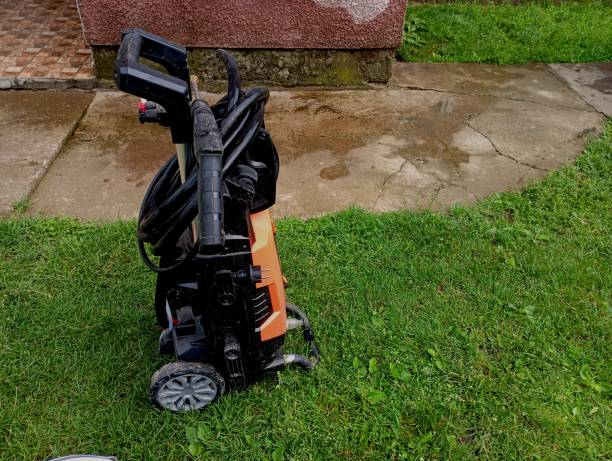
3. The Heart of the Pump: The “Alchemy” of Volumetric Pressure Boosting
If we are to talk about the generation of pressure, we must understand the concept of a “positive displacement pump.” This is the basis of physics.
Imagine a syringe: when you push the piston and the outlet is blocked, the pressure rises sharply. The pump body of a cleaning machine is composed of three or more such miniature “syringes.”
Suction Stroke: When the swashplate rotates to the lowest position, the spring pushes the piston back. The pump chamber volume expands, creating a partial vacuum. At this point, the one-way inlet valve opens, and low-pressure water is drawn into the pump chamber.
Compression Stroke: The swashplate rotates to its highest position, forcibly pushing the piston into the pump chamber. Since water is an incompressible fluid, as the space shrinks dramatically, water molecules have nowhere to escape, and the pressure increases exponentially. At this point, the inlet valve closes, and the high-pressure water forces open the outlet valve, rushing towards the high-pressure pipe.
To ensure a steady, rather than pulsed, water flow, these pistons move alternately under the drive of the swashplate, ensuring a continuous flow of water at all times.
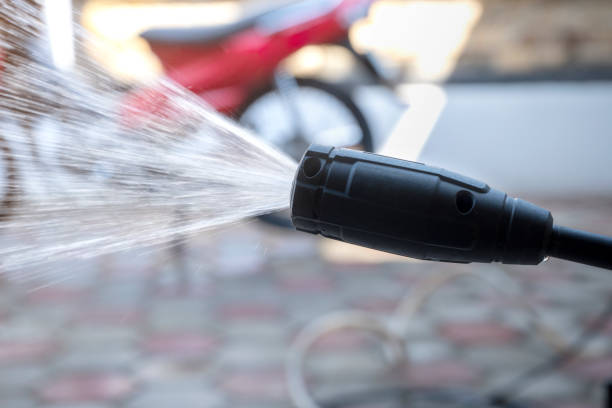
4. Close Encounter: The Nozzle Delivers the Final Blow
This is a very common misconception: many people believe that pressure is “created” by a pump.
From a rigorous definition in fluid mechanics: a pump only generates flow, while pressure is generated by the restriction of flow.
Application of Bernoulli’s Principle: The water flow discharged from the pump carries a huge volume to the nozzle. The nozzle orifice is extremely small (the limiting point), forcing the water flow to accelerate through.
Kinetic Energy Conversion: At the narrow exit of the nozzle, enormous potential energy is instantly converted into astonishing kinetic energy. It is this high-speed impact force (rather than static pressure) that accomplishes the task of removing dirt.
Experts advise that the nozzle orifice diameter determines the final pressure (PSI). Replacing the nozzle with a smaller orifice increases resistance and raises system pressure; conversely, a larger orifice nozzle will reduce pressure and increase flushing flow.
5. The System’s “Brain”: The Unloader Valve
Why doesn’t the machine explode when you release the spray gun trigger, but the motor is still running? This is thanks to the unloader valve.
Function: When the spray gun is detected to be closed (pipeline pressure surges), the unloading valve will activate instantly, cutting off the water outlet passage and guiding the water flow to circulate internally within the pump head (bypass loop).
Significance: This not only prevents the pump body from being damaged by overpressure but also allows the motor to continue running under no-load conditions (or triggers automatic shutdown), ready for the next injection at any time.
FAQ: Frequently Asked Technical Questions
Q1: Why does my electric pressure washer still make a buzzing sound after I turn off the spray gun?This is usually because the machine is not equipped with (or has a faulty) Total Stop System (TSS). The motor is running continuously, and water is circulating at high speed through the unloading valve inside the pump.Note: Prolonged internal circulation can cause a sharp rise in water temperature, which may damage the seals (a condition known as “thermal shock”). It is recommended to manually shut off the machine if the spraying is paused for more than 1 minute.
Q2: How can I tell if the pump body is damaged or the nozzle is clogged?
Nozzle Blockage: abnormally high pressure, which may even cause the motor to overload and stop or the water spray pattern to become forked.
Pump Body/Check Valve Damage: pressure drops significantly, the motor sounds very brisk (low load), or water flow has a noticeable pulsating sensation (jerking).
Q3: Is there a difference in the water pressure mechanism between electric and fuel-powered models?
The basic physical logic (positive displacement pump) is the same. The core difference lies in the torque of the drive source and the size of the pump body. Combustion engines typically provide a larger flow rate (GPM), making them suitable for large-area operations, while electric pressure washers focus on a balance between immediate response and energy efficiency for home use.