Achieve professional-grade storage by wall-mounting an electric pressure washer.

Every time you think about simply rinsing off the dust on your car, the thought of dragging it out, connecting the water hose, the electrical wires, and untying that perpetually crooked high-pressure hose might make you give up and go back inside.
This “use resistance” is the culprit that turns expensive tools into dusty decorations.
PSI butI’ve discovered that true cleaning freedom doesn’t come from buying machines with higher PSI, but from completely transforming their form. Today, we’ll explore the ultimate solution inspired by the “Obsessed Garage” aesthetic: ditch the original casing and transform your cleaning equipment into the sexiest piece of industrial art on your garage wall through a wall mount electric pressure washer setup.
Why hang it on the wall? (The Philosophy)
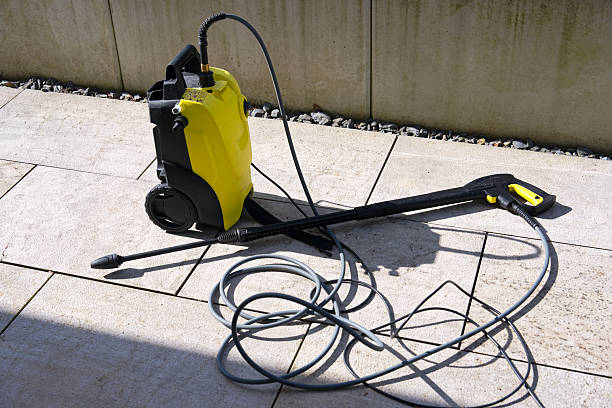
Most consumer-grade electric pressure washers are designed for “mobility.” Manufacturers assume you’ll drag it around the house. But in reality, if you have a long enough 50-foot high-pressure hose, the machine itself doesn’t need to be moved at all.
Those bulky plastic shells and wobbly wheels are actually just a burden.
Wall-mounting machines isn’t just about saving floor space; it’s about eliminating “preparation time.”
Imagine walking into your garage, reaching for the hose, pressing the switch on the wall, and it’s instantly working. This “plug and play” experience transforms your resistance to car washing into a joyful experience.
In building such an efficient garage electric pressure washer ecosystem, you’ll find that established infrastructure contributes far more to your well-being than obsessing over machine parameters.
Step 1: Strip away the disguise and return to the core (The Teardown)
spirit.”To achieve this minimalist aesthetic, you need a bit of “disruptive spirit”.
motor unit).Many electric pressure washers on the market are essentially just a compact motor pump unit crammed into a huge plastic casing. What you need to do is remove the casing and take out the core unit (pump and Motor Unit).
electric pressure washer,Of course, not all machines are suitable for this “naked” approach. You’ll need to look for models with a compact design and a logical inlet/outlet layout. If you’re looking for a suitable Electric Pressure Washer, consider these minimalist designs, as they are often easier to fit with universal mounting brackets.
Once the core is removed, you’ll need a DIY pressure washer shelf.
capacity butI don’t recommend using ordinary wood planks, as moisture and vibration are killers for wood. Stainless steel shelves or aluminum alloy shelves are the best choice. This is not only for load-bearing capacity, but also for heat dissipation and that cool, industrial look.
—TheStep Two: Soulmate – The Reel
If the main unit on the wall is the heart, then the Hose Reel for Electric Pressure Washer is the soul of this system.
hose andDitch that stiff, knot-prone original PVC hose. You’ll need a high-quality, kink-resistant rubber hose, and install it in an automatic retractor.
Once you experience the silky smoothness of pulling out the hose and the elegant way it automatically retracts and coils after you let go, you’ll never want to go back to manual storage.
When planning your layout, it’s recommended to install the hose reel as close to the garage door as possible. This way, you can easily cover vehicles inside the garage and also pull it directly to the driveway to wash the surrounding area.
Step 3: The Art of Piping and Connections (Plumbing & QC)
“connection.”The most fascinating detail in the wall-mounted electric pressure washer setup is the “connection”.
You don’t want a mess of hoses hanging on your wall. You’ll need to introduce jumper hoses to connect the water source, machine inlet, outlet, and hose reel.
At this point, all-brass or stainless steel quick connectors (QCs) are essential.
Ditch those plastic threaded connectors and switch to standard 3/8-inch quick connectors. The crisp, metallic click of the metal engaging provides an indescribable sense of satisfaction from the precision mechanics.
wall orYou need to plan the water inlet path: should you pre-install water pipes in the wall, or connect to the nearest faucet via a short pipe? The location of every bend and every valve reflects your understanding of efficiency.
This is not just about cleaning.
Once you’ve finished all that and are standing in the middle of the garage, looking at the gleaming electric pressure washer system on the wall, you’ll realize that this has gone beyond the scope of a “car wash tool.”
It’s a declaration of a lifestyle. It tells everyone who walks into your garage: the owner here doesn’t care about compromise; he pursues ultimate order and efficiency.
This systematic transformation has turned cleaning from a chore into a stress-relieving ritual. You no longer wash your car just to get it clean; you wash it to enjoy the process of using this perfect system.
Take immediate action (Actionable Tip):
- Don’t try to complete all the renovations at once.
- This weekend, take the first step: measure the available space on your garage walls and find a “golden spot” that’s close to both power outlets and water sources.
- Then, go to a hardware store and buy two heavy-duty shelf brackets.
- Put your electric pressure washer on them and experience the convenience of “no bending over.”
Once you’ve tasted the benefits, the rest of the renovations will fall into place naturally.
FAQ
1. Are all electric pressure washers suitable for wall-mount retrofitting?
No. Some integrated machines (especially vertical models) have very fragmented internal structures, meaning the motor and pump cannot stand or be secured independently after removing the outer casing. Horizontal designs or compact “handheld” models are best suited for modification. Before starting your DIY pressure washer shelf project, be sure to search online for teardown diagrams of your model to confirm the shape of the core unit.
2. After wall mounting, how do I solve the water supply connection problem?
This is the most crucial part of setting up a wall-mounted electric pressure washer. The usual practice is to install a dedicated inlet faucet on the wall or to use a high-quality inlet hose to permanently connect to a nearby household faucet. To prevent vibration transmission, it is recommended to use a short, flexible hose connection between the machine’s inlet and the rigid wall hose.
3. Will using a seat reel for an electric pressure washer cause pressure loss?
Theoretically, there might be a slight drop, but it’s negligible for home use. As long as you choose a high-pressure hose with the correct inner diameter (usually 3/8 inch) and a suitable length (50-75 feet), the pressure drop will typically not exceed 50-100 PSI, which has no visible impact on the actual cleaning effect. Compared to the immense convenience brought by the hose reel, this slight loss is entirely worthwhile.