Why is it necessary to perform the “release pressure” step after using an electric pressure washer?
You’ve just finished washing your muddy SUV or moss-covered patio with an electric pressure washer. Looking at the sparkling clean floor, you feel incredibly satisfied. So, you casually turn off the power switch, unplug the machine, coil up the hose, and push it back to the corner of the garage.
Sounds like a perfect finishing move?
As an observer who has disassembled countless machines that “mysteriously broke down” in this industry, I want to tell you a harsh truth: the moment you turn away, you leave a “time bomb” in the heart of that machine.
This bomb is residual high pressure.
Most users believe that turning off the switch (OFF) means the machine stops working. However, in the physical world of hydraulic systems, the motor stopping does not mean the pressure within the system disappears.
If you don’t perform that mere 5-second “micro-operation,” this trapped high pressure will continue to attack the most vulnerable sealing components of your electric pressure washer for weeks or even months until it completely fails.
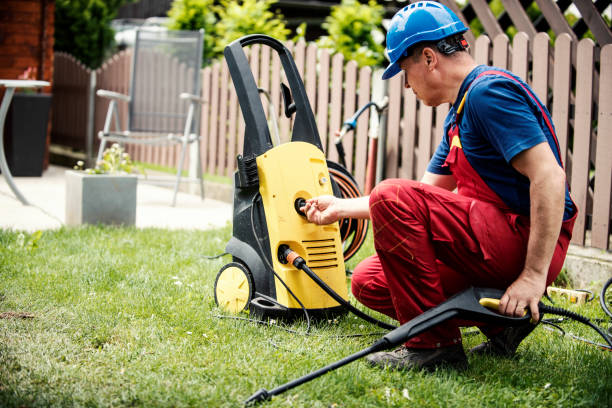
The Invisible Enemy: The Physics of Hydrostatic Pressure
To understand why this step is a matter of life and death, you need to imagine what happens inside the high-pressure pipe.
When you release the spray gun trigger, the unloader valve of the modern electric pressure washer will immediately activate, cutting off the water flow and bypassing the water flow inside the pump head, or directly cutting off the motor power through the total stop system.
At this point, although the motor has stopped, the water is still firmly “locked” at a high pressure of several thousand PSI in the pipeline between the pump head outlet and the spray gun trigger. Water is an incompressible fluid, which means that this enormous force will not dissipate slowly like air; it will act like a tightly wound spring, continuously searching for a way out.
Consequence 1: The “slow death” of the sealing ring
This pressure, with nowhere to go, first attacks the seals (seals/O-rings).
Inside the pump head of an electric pressure washer, there are multiple precision rubber seals responsible for locking water within specific chambers. If the machine is not depressurized after being turned off, these rubber components will be forced into a compressed and deformed state for an extended period.
Imagine pressing a piece of memory foam firmly with your finger for a long time. After a few days, if you release it, will it return to its original shape? The same principle applies to rubber seals. Prolonged static pressure can cause rubber to lose its elasticity, resulting in permanent deformation.
Consequence 2: Motor burnout caused by “jamming.”
Many users encounter a strange phenomenon when they take the machine out again after a period of time: when the power is turned on, the motor makes a muffled buzzing sound, but it just doesn’t turn, and after a few seconds they can even smell a burning smell.
At this point, many people will search for “pressure washer pump stuck.”
In reality, this is often not a pump malfunction but rather a problem caused by unreleased pressure from the previous operation. The check valve or piston is held in place by the high pressure, generating significant static friction.
The motor’s starting torque is insufficient to overcome this resistance, leading to a stall. This stall generates a sudden surge of current, which can easily burn out the capacitor or even the motor windings.
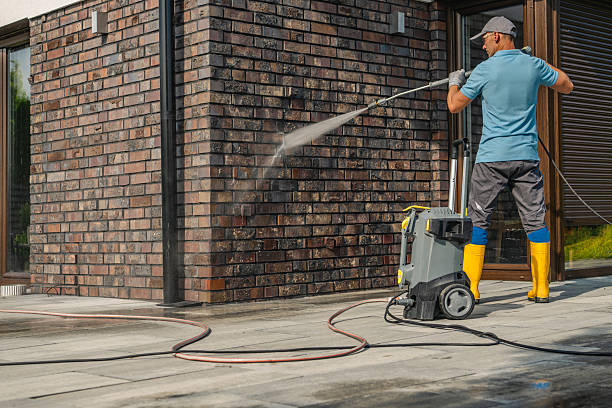
Key Steps: How to Properly Perform “Stress Relief”
Now that the dangers are known, the solution is surprisingly simple and costs nothing.
This is not just an action but a ritual.
- Turn off: Turn the power switch on the machine to the OFF position.
- Water Off: Turn off the water tap.
- Squeeze the trigger: This is the most crucial step. Pick up the spray gun, point it at a safe area, pull the trigger, and hold for at least 5 seconds.
You will see a stream of water spurt out, which may initially have some force, then quickly weaken until it becomes a few drops. At this point, you will feel the reaction force on the handle completely disappear.
This means that you have successfully performed the pressure relief electric pressure washer operation, and the pressure inside the machine has returned to atmospheric pressure.
Winter Special: The Last Line of Defense Against Frostbite
If you live in an area at risk of freezing temperatures, this step is absolutely essential.
Many people searching for “winterizing electric pressure washer mistakes” only focus on whether antifreeze (pump saver) was added but ignore the venting pressure.
If high-pressure water remains in the high-pressure line, when the temperature drops below freezing, the expansion force of the water upon freezing (a 9% increase in volume), combined with the original high pressure, is enough to crack the metal pump head like cutting tofu.
Releasing pressure not only protects the seals but also allows water to flow out naturally, making room for the antifreeze. Regarding this complex fluid freezing mechanics mechanism, I previously… Electric pressure washer notes There’s some good content there that I hope will be helpful to you.
Build muscle memory
Don’t mistake the electric pressure washer for an ordinary household appliance. It is a power-operated tool that uses sophisticated mechanics to pressurize water to dangerous levels.
Treat it like a firearm: once it’s used, you must “unload it.”
Next time you’re about to finish work, force yourself to take those extra 5 seconds: turn off the machine, turn off the water, and pull the trigger.
Those few seconds can save you hundreds of dollars in repair costs and extend your machine’s lifespan by several more years. Don’t wait until the pump head cracks to regret not developing this cost-free habit.
Be a smart operator, not a consumer who only knows how to buy new machines.
FAQ
1. Why is there still pressure in the tubing of my electric pressure washer several hours after it has been turned off?
This indicates that your machine is well-sealed, which is a good thing, but it also implies a risk. Modern machines have highly sophisticated high-pressure check valves designed to prevent pressure backflow.
If you don’t manually pull the trigger to activate the pressure relief electric pressure washer, this pressure is trapped between the hose and the pump head, theoretically able to remain leak-free for several days, continuously pressurizing the internal components.
2. Is it only necessary to release stress before storing for winter?
Absolutely not. This is a standard procedure that must be followed “after every use.” Even if you need to use it again tomorrow, the pressure must be released tonight.
The plastic deformation of the rubber seal is an irreversible cumulative process, and even just overnight high-pressure retention will accelerate the risk of the pressure washer pump getting stuck and shorten the life of the parts.
3. I forgot to release the pressure, and now the machine won’t start. What should I do?
If you encounter a typical consequence of winterizing electric pressure washer mistakes—the motor hums but doesn’t turn—first, immediately disconnect the power! Then, with the pump off, pull the trigger to try and release residual pressure.
If water doesn’t flow, the valve core may be stuck. Do not force it to start.
Try disconnecting the high-pressure outlet pipe to reduce the back pressure on the pump head, then try briefly starting the motor. If this still doesn’t work, you may need to manually rotate the motor fan blades to assist in starting it.
Related Posts
Don’t be fooled by PSI: A deep dive into the secrets of Electric Pressure Washer motors (Induction vs. Universal)
-
Posted by
 Marcus Whitfield