Electric pressure washers can save up to 70% more water than regular garden hoses?

This sounds like a counterintuitive paradox: how could a high-pressure machine that can make a roaring sound and even cut cork possibly save more water than a quietly flowing garden hose?
If you are standing in the driveway and looking The powerful jet of water from an electric pressure washer might trigger your instinctive reaction:
“This thing is a water monster; my water bill is going to explode.”
This is the first psychological barrier most people face before buying it, and it’s also the biggest misconception about pressure cleaning.
As a tech observer who has validated countless devices in this industry using fluid dynamics data, I’m here to tell you a mathematical fact that might challenge your common sense:
When performing the same cleaning task, using a pressure washer not only saves water but can actually save up to 70% or more compared to a regular garden hose.
Today, we’ll use hardcore data and fluid physics to break down this efficiency battle between garden hoses and pressure washer GPMs.
The truth about data traffic: A stark comparison of GPM
To unravel this mystery, we must first understand two core concepts: PSI (pressure) and GPM (gallons per minute).
A typical garden hose is a classic “low-pressure, high-flow” system. When you turn on the tap, water flows unimpeded through a 5/8-inch hose. Depending on the water pressure in your area, the flow rate of a garden hose is typically between 6 and 10 GPM (22 to 37 liters per minute).
This means that every minute, tens of liters of water are wasting their time—they simply flow over the surface without generating enough force to strip away dirt.
In contrast, an electric pressure washer is a “high-pressure, low-flow” system. Regardless of how high its PSI is rated (2000 or 3000 PSI), its core design logic is to increase flow rate by limiting flow rate. The vast majority of household electric washer machines on the market have a rated flow rate of only 1.2 to 1.5 GPM (4.5 to 5.7 liters per minute).
| System | Flow Type | GPM Range | LPM Range |
|---|---|---|---|
| Garden Hose | Low-pressure, High-flow | 6-10 GPM | 22-37 LPM |
| Electric Pressure Washer | High-pressure, Low-flow | 1.2-1.5 GPM | 4.5-5.7 LPM |
You’ll find it’s a staggering difference: a hose loses 5 to 8 times more water per minute than a washer uses per minute. If you’re planning a sustainable cleaning solution for your home, understanding the core water-saving aspect of this electric pressure washer is crucial; it can fundamentally reshape your perception of household water efficiency.
Scenario Simulation: The Math Problem of Car Washing
Let’s bring the data into real life. Imagine the most common scenario: eco-friendly car washing at home.
Let’s say you’re a meticulous car owner who needs 20 minutes to wash a muddy SUV.
Use garden hoses: Even if you exercise extreme restraint, at an average rate of 8 GPM, a 20-minute continuous rinse will consume 160 gallons (approximately 600 liters) of water. That’s equivalent to the volume of three standard bathtubs. The water flow is mostly just “bathing” the car body, not “cleaning” it.
Using an Electric Pressure Washer: Even if you keep pulling the trigger the whole time (which is practically impossible, as we’ll discuss later), at 1.5 GPM, it would only consume 30 gallons (about 113 liters) of water in 20 minutes.
This isn’t just about saving money; it’s a difference of orders of magnitude. In arid regions or cities with expensive tiered water pricing, this difference directly determines whether you’re “maintaining an asset” or “wasting resources.”
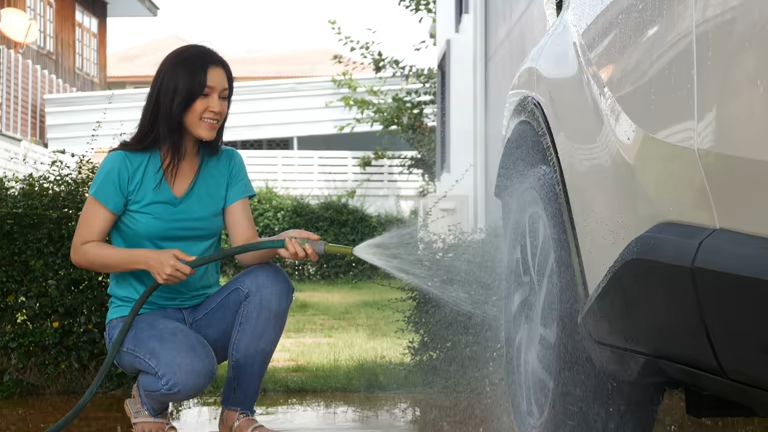
Physical principle: Kinetic energy replaced the amount of water.
You might ask, “Can such a small amount of water really get it clean?”
The secret lies in the kinetic energy formula in physics: $E_k = 1/2 mv^2$.
Cleaning power depends primarily on kinetic energy. Garden hoses attempt to flush away dirt by increasing m (mass/water volume), a clumsy and inefficient method. Electric pressure washers, on the other hand, generate enormous kinetic energy by greatly increasing v (velocity).
When water is pressurized and ejected through a narrow nozzle, it not only travels at extremely high speeds but also typically entrains air in the process. These high-speed water droplets mixed with air strike the dirty surface like countless tiny bullets, physically stripping away dirt, moss, or oil.
In other words, we are cleaning with “speed,” not with “water.”
Hidden Variables: Triggers and the TSS System
Besides the hard data comparison of garden hose vs. pressure washer GPM, there is another behavioral variable that is easily overlooked: trigger time.
When you use a garden hose to wash your car or rinse your patio, the water is usually constantly running. Even if you have a spray gun, the water often continues to flow at a low rate while you move around, check the cleanliness, or wipe the sponge down, or you might be too lazy to turn off the tap.
However, an electric pressure washer forces you to change your habits. Water only sprays out when you pull the trigger; once released, the TSS (Total Stop System) of modern machines immediately cuts off the motor and water flow. This “on-demand” mechanism means that for the same cleaning task, the actual water flow time is often only half that of a garden hose.
This difference in mechanism actually serves as a positive constraint on user behavior. Regarding this complex electromechanical water-saving mechanism, my previous guide to electric pressure washers provides more empirical data to support it; data enthusiasts can delve deeper into it.
Be a shrewd “water resource manager.”
When we talk about how much water an electric pressure washer uses, the answers we get are often surprising. Buying a pressure washer may seem like a purchase for stronger cleaning power, but in reality, you’re buying a highly efficient “water resource management device.”
It breaks the traditional myth that “only a lot of water can clean it” and uses technology to improve efficiency.
Take immediate action (Actionable Tip):
If you’re still skeptical, try a simple “bucket test” this weekend: Take a 5-gallon bucket. First, fill it fully with water using a garden hose and time it to see how long it takes to fill (usually less than 30 seconds). Empty the bucket, then fill it again with your electric pressure washer; you’ll find it might take 3 to 4 minutes to fill. This huge time difference is the real money you’ll save.
FAQ
1. Given this, what is the specific value of how much water an electric pressure washer uses?While there are some differences between models, the flow rate of most household electric sprinklers is strictly limited to between 1.2 GPM and 1.8 GPM. In contrast, even water-saving garden sprinklers have a flow rate of over 5 GPM. Therefore, even an entry-level machine consumes only 1/4 to 1/5 of the water used by a water pipe per unit time.
2. In the comparison of GPM between garden hose and pressure washer, is a lower GPM always better?That’s not the case. While we need to conserve water, we must ensure basic flushing power. If the GPM is below 1.0, although the pressure (PSI) may be high, the water flow is too weak to effectively flush away the loosened dirt, resulting in extremely low cleaning efficiency. For home use, 1.2 to 1.5 GPM is the optimal balance between water conservation and cleaning efficiency.
3. Is using a pressure washer really an eco-friendly way to wash your car at home?Absolutely. Besides saving over 70% of water, the physical stripping power of high-pressure water also reduces your reliance on chemical cleaners. Often, the high-pressure impact of pure water is sufficient to remove dirt, meaning not only less water flows down the drain, but also fewer chemical contaminants. This is one of the most environmentally friendly ways to clean your home.