Electric Pressure Washers and Renewable Energy: A Clean and Sustainable Future

On city rooftops, solar panels gleam with a metallic sheen; in a corner of a yard, an electric pressure washer quietly cleans muddy tools. Sunlight and high-pressure water—two seemingly unrelated forces—are merging in a novel way, redefining the meaning of “clean energy.”
As more and more households and businesses embrace green transformation, the combination of electric high-pressure washers and renewable energy is becoming a noteworthy innovation. This isn’t just about a change in electricity sources; it’s also about the future of energy efficiency, environmental responsibility, and technological evolution.
Redefining “Electricity”: When Electric Pressure Washer Meets Solar Energy
Over the past decade, electric pressure washers have gradually replaced fuel-powered equipment. Their lower noise levels, reduced emissions, and ready-to-use convenience have made them a key environmental leader in the cleaning industry. However, amidst the shifting global energy landscape, simply relying on electricity is no longer sufficient.
The question is—if the power grid itself still relies on fossil fuels for power generation, then is so-called “clean equipment” truly environmentally friendly? This is the core logic of combining solar and electric equipment: to clean the process from the source.
According to the International Energy Agency (IEA), solar power generation will grow at an annual rate of over 25% through 2024, making household photovoltaic installations one of the fastest-growing green investments globally. Meanwhile, portable solar energy storage devices are rapidly gaining popularity, making it possible to connect high-pressure washers to solar systems.
This system typically consists of three components: photovoltaic panels, an inverter, and energy storage batteries. During the day, solar energy is converted into electricity, stored in the battery, and then driven by the inverter to operate the electric pressure washer.
The results are clear—zero fuel consumption, zero carbon emissions, low noise, and zero maintenance costs.
The energy efficiency logic of continuous cleaning: from batteries to efficiency
However, the real challenge isn’t whether it can be used, but how long it can last.
A high-pressure washer can draw 1,500 to 2,000 watts of power in a split second, while a typical portable solar system can only provide 600 to 1,000 watts of continuous power.
This means that to stably power a high-power electric pressure washer, the system design must be optimized:
- High-density energy storage: Using lithium iron phosphate (LiFePO₄) batteries, it can provide longer cycle life and stable output;
- Smart inverter: optimizes light energy conversion efficiency through MPPT control;
- Intermittent cleaning strategy: Utilize intermittent power supply mode to store energy during peak hours and discharge for cleaning during off-peak hours.
Interestingly, several European outdoor cleaning brands have already launched prototypes.
solar-powered pressure washers. These utilize modular power units, allowing them to operate in off-grid locations such as fields, farms, and docks. While the current washing pressure is slightly lower than traditional models, their self-sufficient energy model opens up new possibilities for mobile cleaning equipment.
The value behind this is not only energy saving but also a symbol of “energy autonomy”—making cleanliness no longer dependent on external power systems.
Environmental impact: Closing the loop from power saving to carbon neutrality
An ordinary electric pressure washer consumes about 1.8 kilowatts of electricity per hour. If calculated with traditional thermal power, it will indirectly produce about 1.3 kilograms of carbon dioxide emissions per hour.
However, if it is powered by solar energy, this figure will be close to zero.
And these savings aren’t just theoretical. According to CleanTech Research, more than 12 million high-pressure washers are used in Europe each year, both domestically and industrially. If even 10% of these were powered by solar energy, it would save approximately 24,000 tons of CO₂ emissions annually.
In addition, solar-powered electric pressure washers have additional advantages in terms of noise, maintenance, and safety:
- No need for fuel storage, avoiding safety hazards;
- No tail gas emissions, suitable for closed environments;
- The low noise feature makes it more suitable for residential areas, schools, hospitals, and other places.
Environmental protection is no longer a slogan here but a product of systematic upgrading.
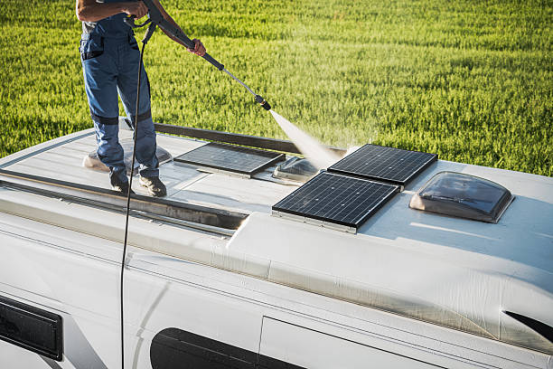
Technology Convergence and Industry Trends: The “Energy Awakening” of Clean Equipment
In fact, the integration of electric pressure washers and renewable energy is becoming an integral part of the future “smart home ecosystem.”
Leading brands are already developing IoT-based energy optimization systems that automatically adjust wash schedules based on weather forecasts and automatically activate the device during peak sunlight hours, maximizing solar energy utilization.
This combination of AI and cleaning equipment isn’t just about improving efficiency; it’s also about eco-friendly thinking.
Imagine this: when your rooftop photovoltaic array, energy storage batteries, and cleaning equipment form a closed-loop system, you’re not just cleaning your terrace or car; you’re also cleaning up our old energy-wasting habits.
On the industry side, relevant trends have emerged:
- Portable cleaning equipment combined with renewable energy components has become a new blue ocean in the camping and outdoor markets;
- Commercial-grade cleaning systems are being integrated with green building projects, becoming a bonus for LEED certification;
- Platforms for shared cleaning equipment, such as solar-powered high-pressure machines that communities can rent, are being piloted in some countries.
It can be said that this transformation is not an isolated innovation but an important part of the green technology landscape that cannot be ignored.
From concept to practice: the future has arrived, but breakthroughs are still needed
Of course, any technological change comes with costs and resistance.
The current bottlenecks are mainly in two areas:
- —pricesHigh costs – prices of high-efficiency photovoltaic panels and energy storage systems remain high;
- Insufficient power density—Solar energy systems are still limited in their ability to withstand instantaneous high power loads.
It’s worth noting, however, that these issues are gradually being addressed with the advancement of lithium battery recycling systems and carbon neutrality policies.
Future electric pressure washers may feature built-in, replaceable energy storage modules and even a “hybrid power supply mode”—automatically switching to grid power when sunlight is insufficient to ensure continuous operation.
What we see is no longer a simple cleaning device but a carrier of a sustainable lifestyle.
The era of sunlight cleaning is beginning
When sunlight becomes energy, and when washing is no longer consumed but recycled—the Electric Pressure Washer may become a symbol of the realization of green energy.
This is not just a technological innovation but a shift in perspective: we no longer ask, “How can we make cleaning more efficient?” but rather, “How can we make cleaning more meaningful?”
In the future, your washing machine might no longer be plugged into a wall socket but instead connected to a rooftop light.
Then, every jet of water would be an extension of solar energy—clean, quiet, long-lasting, and with a touch of technological romance.